
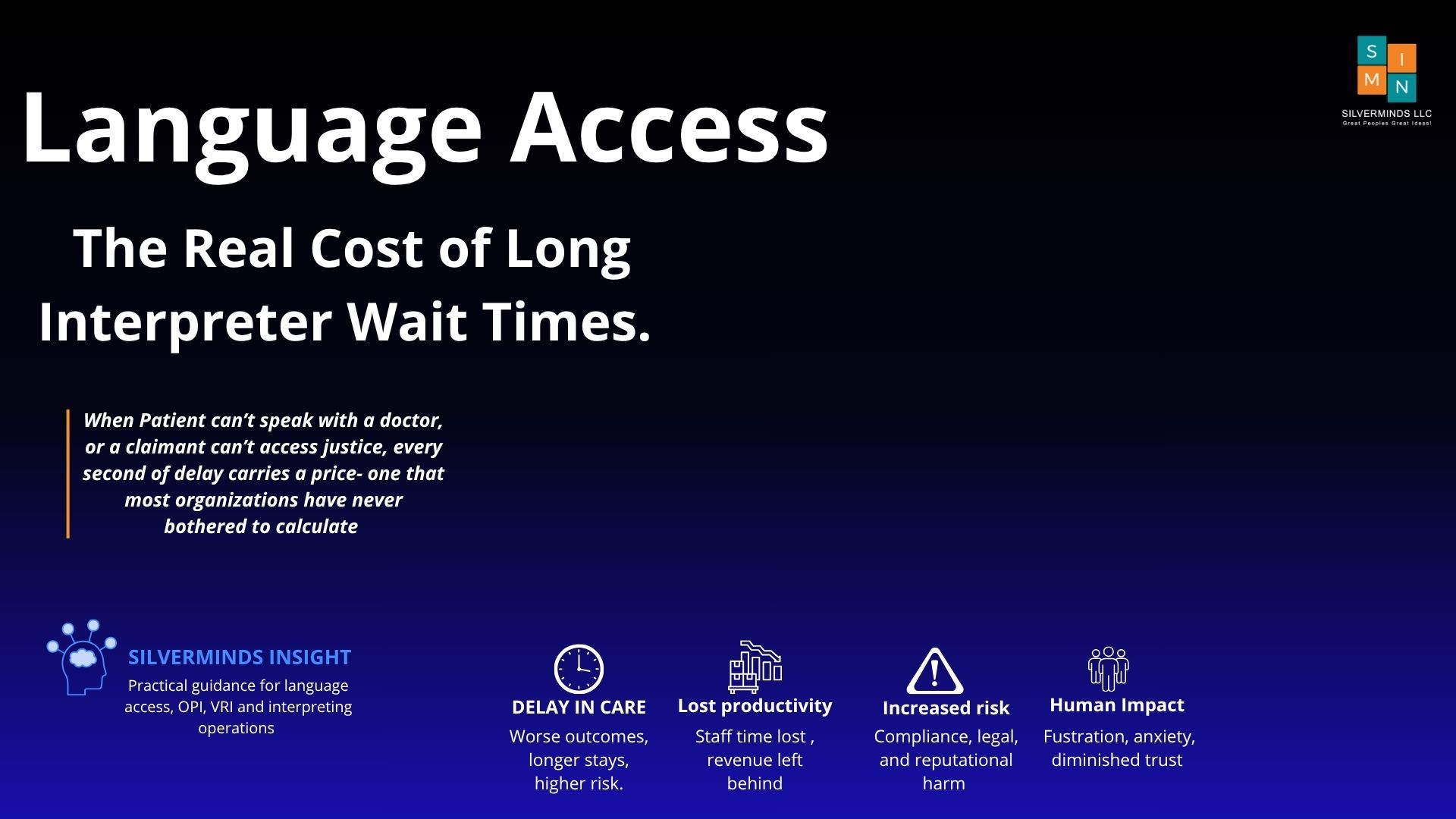
Across hospitals, courtrooms, insurance call centers, and government offices, a quiet crisis plays out thousands of times each day. A patient with limited English proficiency arrives for a critical appointment. A claimant calls to dispute a denied benefit. A defendant waits to understand the charges against them. In each case, help is available — in theory. In practice, it is delayed. And in that delay, real harm quietly accumulates.
Interpreter wait times have long been treated as a scheduling nuisance, a workflow inconvenience to be managed rather than eliminated. But a closer examination of the data — across healthcare, legal services, insurance, and government — reveals something far more serious: wait times are one of the most underestimated cost drivers in any organization that serves a linguistically diverse population.
"Every minute a limited-English speaker waits for an interpreter is a minute of care withheld, productivity lost, and risk accumulating — invisible to the balance sheet but very real to the person waiting."
The Hidden Arithmetic of Waiting
The most immediate cost is the one that rarely appears on any ledger: staff time. When a nurse, case manager, or claims adjuster waits with a patient or caller for an interpreter to connect, billable capacity evaporates. Studies of hospital systems with on-site interpreting models find that clinical staff routinely spend 20 to 45 minutes per encounter in unproductive waiting — time that, at fully loaded costs, can exceed $80 per incident. Multiply that across a mid-sized hospital's LEP volume and the annual figure runs well into seven figures.
Call centers face a parallel problem. In BPO environments serving insurance carriers or government contractors, average handle time for LEP callers using telephonic interpreting with high latency can run 30 to 50 percent longer than English-language calls. Some of that difference reflects genuine complexity. But a significant share is simply structural delay: time spent waiting for an interpreter to connect, time spent managing the three-way awkwardness of a slow or unresponsive bridge, and time spent repeating information after dropped connections.
These are the visible costs. The invisible ones are often larger.
Clinical and Legal Consequences
In healthcare, delayed or inadequate interpretation is not merely an inconvenience — it is a patient safety event. The Joint Commission has identified communication failures as a leading root cause of sentinel events, and language barriers compound every dimension of that risk. When an interpreter takes too long to connect, clinicians make judgment calls: they proceed with a family member as an ad hoc interpreter, they simplify their communication to the point of omission, or they defer care entirely. Each of these workarounds introduces error.
The liability exposure is significant and growing. Title VI of the Civil Rights Act requires any entity receiving federal funding to provide meaningful access to services for LEP individuals — and meaningful access, courts have consistently held, means timely access. Delays that result in adverse outcomes or documented failure to access care have supported seven-figure verdicts and settlements. For health systems, insurers, and government agencies, the cost of a single adverse event attributable to interpretation failure can dwarf years of investment in better interpreting infrastructure.
Legal settings carry their own calculus. In immigration courts, where interpreter demand frequently outstrips supply, cases are continued — sometimes for months — when qualified interpreters cannot be secured. Each continuance extends detention for those held in custody, at a daily cost to the government and an immeasurable cost to the individual. In criminal proceedings, delays in interpreter access compromise the ability to confer with counsel, producing grounds for appeal that can unwind years of judicial work.
"A single adverse event attributable to interpretation failure can dwarf years of investment in better interpreting infrastructure."
The Operational Multiplier Effect
Beyond the direct costs of individual encounters, wait times create a multiplier effect throughout operations. In healthcare, delayed interpretation contributes to longer lengths of stay — the metric that, more than almost any other, drives hospital financial performance. Research published in health services journals has found that LEP patients experience hospital stays that average one to two days longer than comparable English-proficient patients, with communication barriers accounting for a meaningful share of that difference. At average daily hospital costs exceeding $2,800, the financial impact is straightforward to calculate and difficult to ignore.
Call centers experience an analogous dynamic. When handle times inflate due to interpreting friction, queue depth increases, abandonment rates rise, and service level agreements come under pressure. In contact center economics — where labor is the dominant cost and occupancy rates are managed to fractions of a percentage point — systematic handle-time inflation for LEP callers represents a structural inefficiency that compounds over time. Organizations that have invested in reducing that friction through better OPI platforms report meaningful improvements in both cost per contact and customer satisfaction scores for their LEP segments.
What Better Infrastructure Actually Changes
The technology gap between average and best-in-class interpreting platforms has widened considerably in recent years. Legacy telephonic interpreting services — characterized by multi-step access codes, unpredictable hold times, variable audio quality, and limited language availability outside standard business hours — are increasingly compared unfavorably to modern OPI and VRI platforms designed around rapid connection, SIP/PBX integration, and API-accessible workflows.
The operational difference is measurable. Organizations that have moved from legacy telephonic models to purpose-built OPI infrastructure report average connection times falling from three to five minutes to under thirty seconds for common language pairs. At scale, that difference translates directly into reduced handle times, higher staff capacity, and — in clinical settings — faster care delivery with lower documentation burden.
For language service providers, the technology layer is increasingly the competitive differentiator. LSPs that can offer clients white-labeled OPI infrastructure with reliable connection speeds, broad language coverage, and integration into existing telephony stacks are winning business that a decade ago was competed on interpreter pool size alone. The interpreter is still the irreplaceable human element. But the infrastructure that connects that interpreter to the person who needs them has become a product in its own right.
Calculating the True Cost for Your Organization
Most organizations have never performed a rigorous cost-of-delay analysis for their LEP encounters. The inputs are more accessible than they appear: average staff cost per minute, average wait time per interpreting request, volume of monthly LEP encounters, and — for healthcare — average length-of-stay differential and daily cost. The resulting figure, annualized, typically surprises leadership. It also reframes the conversation about investing in better interpreting infrastructure from an expense discussion to an ROI discussion.
The organizations most advanced in this analysis have moved further still — incorporating regulatory risk, litigation exposure, and patient or customer retention effects into their models. For those that serve large LEP populations, the fully-loaded cost of inadequate interpreting infrastructure is rarely less than significant, and frequently exceeds the cost of fixing the problem by a substantial margin.
Wait times are not a fact of life. They are a product of infrastructure choices. And the cost of those choices, properly measured, has been hiding in plain sight.
OPI
Healthcare
Language Access
Operations
LEP Services
Compliance